Cary Orthopaedics

Cary - 919.467.4992
Garner - 919.779.3861
Spine Center - 919.297.0000

Knee Arthroscopy

  • Cervical SpineCervical Spine
  • Lumbar SpineLumbar Spine
  • ShoulderShoulder
  • ElbowElbow
  • HipHip
  • Wrist/HandWrist/Hand
  • KneeKnee
  • Ankle/FootAnkle/Foot
  • Knee

    Knee - Minimally Invasive Knee Arthroscopy

    What Is Knee Arthroscopy and How Can It Assist Raleigh, Cary, Garner, Apex and other Triangle Patients?

    Knee arthroscopy involves evaluating the inside of the knee joint with a small telescope and camera (arthroscope). The interior of the knee then is projected onto a viewing monitor by fiber optic cable. This modern technique allows the surgeon to completely visualize and inspect all of the interior structures of the knee joint without needing open surgery.

    Despite the fact that the incisions are quite small, a large amount of surgery can be performed within the knee.

    Knee arthroscopy is usually performed in an outpatient day surgery center.

  • When Would Knee Arthroscopy Be Indicated?
    Meniscal Injury, or Damage to the Cartilage

    Meniscal injury is the most common reason to need a knee arthroscopy. The meniscus (sometimes known as ‘knee cartilage’) acts as a shock absorber in the knee. The torn part of the meniscus can be a source of pain and further damage to the joint (see Meniscal Tears).

    The larger the fragment of meniscus removed the greater the chance of developing arthritis of the knee in the long term. Occasionally in younger patients the meniscus can be repaired. This might require a larger cut if it cannot be done from within the joint. The recovery time is also longer (up to 6 months for complete recovery) for this type of damage to the cartilage and a splint or crutches may be required. The meniscus serves a useful function and we preserve as much of it as possible.

    Meniscal tears, as seen with an arthroscope, may be seen by the patient postoperatively by capturing the arthroscopic view via photos at the time of surgery at our Raleigh, Cary or Garner, NC offices.

  • Articular Cartilage

    Articular cartilage is the smooth lining of the joint which covers the bone. This allows the joint to move normally without friction or pain. If the surface becomes rough or irregular it can cause pain and swelling in the knee. This is the earliest form of arthritis. Knee arthroscopy can help with this but is less reliable than with meniscal tears. A knee arthroscopy cannot cure arthritis and therefore recovery may be less than complete. In the event that arthroscopy is used to debride worn articular cartilage the patient should experience some pain relief, improved function and potentially prolong the patient’s ability to use the knee before potentially undergoing Total Joint Replacement Surgery.

    Arthritis can occasionally be helped by knee arthroscopy, especially if there are recent mechanical symptoms (i.e. locking, clicking) caused by "loose bodies". Loose bodies are unstable pieces of cartilage or bone that float in the knee causing pain, locking or catching.This condition can occur from a variety of causes. These are removed during arthroscopy.
     

  • Diagnostic Knee Arthroscopy

    On occasion, non-invasive testing such as MRI or X-Rays may not fully provide a complete diagnosis. Use of knee arthroscopy can assist the physician in completing the diagnosis of ligament tears, injury to bone or cartilage (lining of the joint), or unexplained pain. This procedure is then useful to determine the suitability for other surgical procedures.

  • Patella-femoral or (Knee Cap) Pain

    Patella-femoral (knee cap) pain is typically and successfully treated by physical therapy first, as it is a difficult disorder to treat surgically. Occasionally, if there are loose fragments of cartilage behind the kneecap, these can be treated with a knee arthroscopy. Your physical therapist will provide you the specific strengthening, flexibility and possible bracing regimen to help you manage or eliminate this type of condition.

  • Cartilage Biopsy and Harvesting

    In the event you have a specific localized area of cartilage damage you may be a candidate for cartilage transplant, a specimen may be taken at the time of your arthroscopy that can be preserved and used at a later time.

  • What Can I Expect As A Result Of This Surgery?

    The results from arthroscopic surgery will depend on the surgical findings and the extent of the underlying condition. In cases of an isolated torn meniscus with no additional damage to the joint, the results are usually excellent. Knees that have incurred meniscal injury may be predisposed towards osteoarthritis since one of the shock absorbers of the joint has been compromised.

    Patients who are found to have damage to the articular cartilage (which lines the joint), are likely to continue to experience symptoms. This is due to the underlying nature of the condition and may be intermittent. Patients who have osteoarthritis are unlikely to gain full relief of symptoms following arthroscopic surgery. Arthroscopic surgery in the presence of osteoarthritis can help if the meniscus is torn or there is loose cartilage in the joint but does not affect the underlying condition, which is likely to gradually progress. Occasionally arthroscopic surgery in the presence of osteoarthritis can make symptoms worse for a period of months. Results in these cases are occasionally disappointing with worsening of symptoms but can provide excellent relief for some patients.

  • How Do I Prepare For The Operation?

    PRE-Habilitation
    It is useful to do some quadriceps (front thigh muscles) exercises prior to your operation. These exercises are designed to maintain muscle strength of the quadriceps group. You will be directed and encouraged to also continue these exercises post-operatively to ensure maximal recovery.
    It is often beneficial to have instructions by the Physical Therapist with this pre-operative exercise program.

    Medical History and Medications
    Discontinue aspirin and anti-inflammatory medications (e.g., voltaren, feldene) 10 days prior to surgery as they can cause bleeding.

    Cease any naturopathic or herbal medications 10 days before surgery as these can also cause bleeding.

    Continue with all other medications unless otherwise specified.

    Notify your surgeon if you have any abrasions or other wounds to the knee.

    Please bring any X-rays, MRI scans or other diagnostic testing results you have had done which may be relevant to your surgery.

    Our surgery scheduling coordinators will advise you of all additional requests and steps to take prior to your surgery date.

    You are advised to stop smoking for as long as possible prior to surgery

    We ask that you complete a health questionnaire at the time of your consultation and prior to your operation. We require information about your past and present illnesses, previous operations, current medications and any known allergies.

    It is important that you inform us of any change in your medications or health status.

    Please take a list of your current medications and known allergies to the surery center on the day of admission and provide this to the anaesthetist who will see you preoperatively.

    Please bring any X-rays, MRI scans or other investigations you have had done which may be relevant to your surgery.

    The operation is usually performed under a general anaesthetic but the final decision rests with the anaesthetist.
     

  • The Surgical Procedure

    You will arrive at the surgical center on the same day of your operation .Prior to the surgery you will be contacted by the surgery center to inform you of the exact times and other pieces of important information.

    The anaesthetist will see you before your operation. You will need to discuss with the anaesthetist your medical history, current medications and any previous anaesthetic problems. Please feel free to discuss with the anaesthetist the type of anaesthetic that will be used (usually a general anaesthetic) and its possible side effects and complications.
    The operation is usually performed under general anaesthesia (i.e. you are asleep). At the end of the procedure the knee is injected with long acting local anaesthetic to keep pain to a minimum.

  • After Surgery

    You may exercise at home up to the point of mild discomfort. Avoid excessive amounts of time on your feet. Squats, kneeling and repetitive stair climbing may serve as an irritant to the knee. It is important to keep the leg elevated and the joint iced as much as possible in the days following surgery.

    It is normal for some blood to collect under the dressings. It is also normal for the knee to develop bruising and stiffness after the operation.

    You will be provided with pain medication for your recommended use for several days after surgery as needed. If you are taking regular anti-inflammatory medications, you may resume these after surgery.

  • When Can I Drive?

    It is not permitted to drive a motor vehicle for 24 hours after having a general anaesthetic. You will therefore need to arrange other transport home from the hospital. It is best to go home with a relative or a friend. You should only resume driving when your knee is comfortable and you have no restrictions in operating your vehicle.This time frame is generally a few days after surgery

    It is recommended that you do not travel long distances by car or plane for at least two and preferably six weeks following surgery as prolonged travel can increase the risk of forming blood clots in the leg.In the event you must travel, it is highly recommended that you take frequent breaks from sitting by walking, pumping the ankle up and down, and walking for short periods of time.

  • When Do I See My Doctor After Surgery?

    We will need to see you in the office about 7 days after surgery.
     

  • When Can I Return To Work?

    You may return to work as your knee condition improves well enough for you to do your particular job. This does not mean that all discomfort must have diminished. There will be some tenderness around the incision sites. It is normal for there to be some slowly resolving discomfort in the knee for several weeks after arthroscopic surgery.
     

  • First Phase Of Recovery

    The primary goal and emphasis in the early recovery phase involves reducing the swelling, strengthening the muscles and reducing pain.

    Pain Reduction
    Significant pain in the knee following an arthroscopic surgery is typically due to overactivity or spending too much time on your feet before the thigh muscles have been adequately strengthened. Excessive swelling can also contribute to pain in the knee.

    It is normal for the knee to be sore and swollen following arthroscopy. Activity should be increased gradually. Avoid prolonged walking or standing for the first few days. Avoid squatting or kneeling or attempting to bend your knee beyond 90 degrees if the knee is painful or swollen.

    Swelling Control and Reduction
    Keep the leg elevated above your heart as much as possible after the operation. Apply an ice pack to the knee for 30 minutes at a time to reduce swelling and pain. You may be provided with a mechanical cooling device to use for the first 2 weeks after surgery. Anti-inflammatory medications can also be helpful in reducing swelling (follow your doctors recommendations). Initially the ice packs or cooling unit should be placed on the bandages and then when the dressing has been removed ensure that you place a cloth between your skin and the ice pack to prevent an ice burn. You will also be required to wear a TED hose for up to 7-10 days after surgery to assist in the prevention of clot formation.

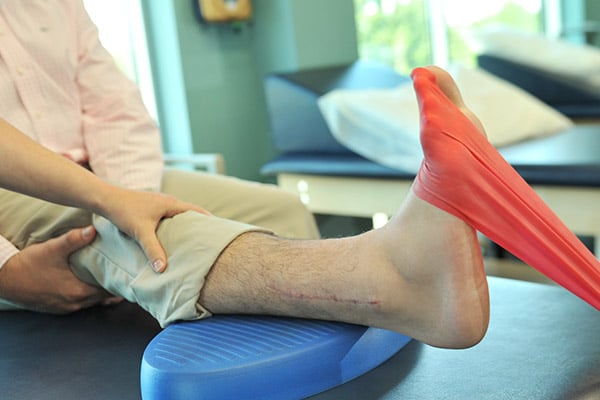
    Knee Strengthening Exercises
    Strengthening your knee muscles, especially the quadriceps, is important in restoring normal function to the knee.

    The physical therapist will have shown you how to do these exercises either pre-operatively or at your first post operative visit. You should continue them on a regular basis for several weeks after the operation following your therapists instructions.

    Following surgery, you will wake up in recovery with your knee bandaged. Most patients will go home on the day of surgery, but some may require an overnight stay. You will require pain medication and may have crutches to go home.

    You surgeon will usually speak with your family member or whomever is attending to you before you go home to explain the results of the operation. These results will be further discussed at your follow up visit.

    Complications
    Any surgical procedure has a risk of complications. These are rare with an arthroscopy, however they can occur. Every precaution is taken to minimize the risk. Complications can be related to the anaesthetic, general in nature it can happen with any surgery or be specific to knee arthroscopy. Your surgeon will discuss operative complication with you at your office visit just before the surgery is scheduled to take place.
     

  • Summary

    Arthroscopy of the knee is a safe, commonly utilized and effective procedure. Each knee problem or injury is unique. Recovery time and the results of the procedure reflect this uniqueness. Complications are rare but can occur. If,at any time, you have further questions or concerns regarding your surgery, please ask before your operation.

    For more information on how the knee arthroscopy specialists at Cary Orthopaedics can help you, contact us today at 919-467-4992 for an appointment!

    Cary Orthopaedics serves patients from Raleigh, Garner, Cary, Apex, Holly Springs, Fuquay-Varina, Clayton, Chapel Hill, and Pittsboro, NC.

Helpful Links

© Copyright Cary Orthopaedics & Sports Medicine Specialists, P. A. All Rights Reserved. Helping patients throughout the Cary, Raleigh, Durham, Chapel Hill metro areas.

We serve clients from the following areas:

Holly Springs | Chapel Hill | Pittsboro | Durham | Dunn | Sanford | Fuquay-Varina | Clayton | Angier | Morrisville | Garner | Lillington | Smithfield | RTP | Apex | Wake County
Alamance County